Contexto
New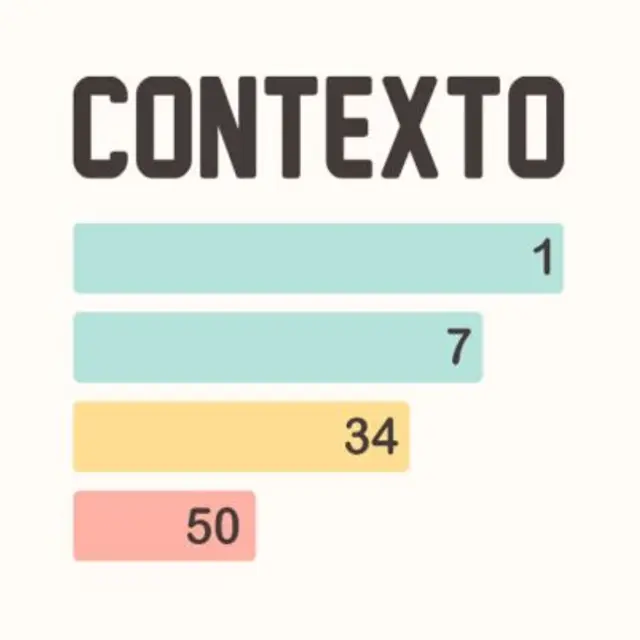
- Genre Educational games
- Players 1
- Session 6 min
- Price Free
- Updated
A daily word puzzle that works on meaning instead of spelling. You guess a word and the game tells you how close it is in sense to the hidden answer — not whether letters match, but whether the concepts are related. That single change makes it a completely different exercise from letter-based word games: you are navigating a space of meanings rather than eliminating characters. The consequence is that progress feels like reasoning rather than guessing. A word ranked close tells you which direction to move, and a word ranked distant is genuinely informative because it rules out a whole region of meaning. There is no guess limit, which sounds forgiving and is not — the score is how many attempts it took, and the players who do well are the ones treating each guess as a probe rather than an attempt. It resets daily, which makes comparing results with other people worthwhile.
| Keyboard | Type a word |
|---|---|
| Enter | Submit the guess |
| Touch | Tap the field and type |
How to play Contexto
- Open with broad, common words to find which region of meaning you are in.
- Move in the direction the rankings suggest rather than guessing synonyms of your best word.
- Use a distant guess deliberately to rule out a whole area when you feel stuck.
- Read the whole list of previous guesses rather than only the closest one.
- Come back daily — the technique transfers even though the answer does not.
Tips
- Very close rankings often cluster around a concept rather than the exact word, so try the category rather than more synonyms.
- Parts of speech matter; if nouns are ranking badly, try a verb.
- A guess that scores worse than everything before it has still told you something useful.
Questions about Contexto
Is it based on spelling?
No, on meaning. Closeness is semantic rather than alphabetic.
Is there a guess limit?
No, but the number of guesses is your score.
Is there a new puzzle daily?
Yes.
Does it help vocabulary?
It rewards thinking about relationships between words rather than recall.
Does it work on a phone?
Yes.
Does it need installing?
No, it runs in the browser.
Is it hard?
Approachable to start and genuinely difficult to do in few guesses.