Ping Pong Go
New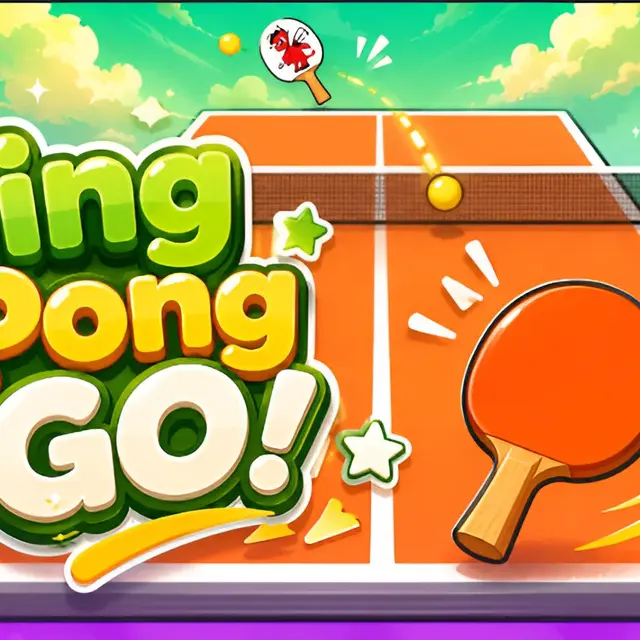
- Genre Sports games
- Players 1
- Session 5 min
- Price Free
- Updated
A table tennis game played from behind the paddle rather than from the side, which changes the skill it asks for. A side-on view makes the game about timing a moving dot; this view makes it about judging depth, and reading how far away a ball is from a third-person position takes noticeably longer to learn. Spin is the other half of it. How you move the paddle through contact decides the curve of the return, so rallies develop rather than just continuing — an opponent who is out of position stays out of position if you put the ball where their recovery cannot reach. Against the computer that is a solvable problem and in special event modes it is harder, since the rules shift per event rather than just raising difficulty. Rallies are quick, matches are short, and the presentation is clean enough that the ball stays readable at speed, which is the only visual requirement that matters. It plays with a mouse, a swipe, or a keyboard, and it runs on very little. A good arcade interpretation rather than a simulation, and it does not pretend otherwise.
| Mouse or drag | Move the paddle |
|---|---|
| Direction of movement | Apply spin through the contact |
| Click or tap | Serve |
How to play Ping Pong Go
- Judge depth from the ball's size and shadow rather than its position on screen.
- Add spin by moving the paddle across the ball, not just into it.
- Return to the centre of the table between shots; recovery position wins rallies.
- Place shots away from the opponent's recovery rather than hitting them harder.
- Serve with spin; a flat serve is the easiest ball to return.
Tips
- Depth judgement is the thing that takes longest to learn from this camera angle.
- Spin placement beats pace, because an opponent out of position stays there.
- Returning to centre between shots is worth more than any individual stroke.
Questions about Ping Pong Go
What is the camera angle?
Third person, behind the paddle.
Does spin matter?
Yes, it decides the curve of returns.
Is it a simulation?
No, arcade.
Are there event modes?
Yes, with shifting rules.
Does it work on a phone?
Yes, with swipes.
Does it need installing?
No.
Is it single player?
Yes, against the computer.