Power Surfer
New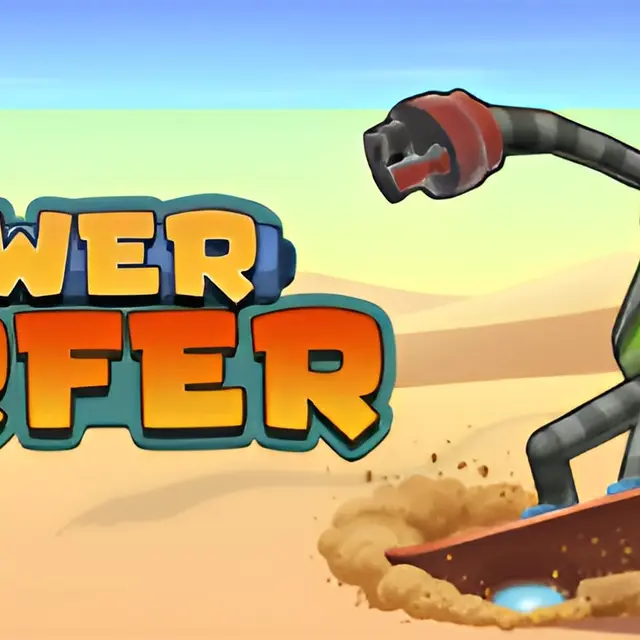
- Genre Skill games
- Players 1
- Session 4 min
- Price Free
- Updated
A hoverboard game whose first run is deliberately unimpressive. The board glides, the terrain is gentle, nothing much happens — and then the ground starts changing shape underneath you, and it becomes clear that the quiet opening was teaching you what neutral balance feels like so that you would notice when it was gone. The mechanic is anticipation rather than reaction. Balance shifts take time to correct, so a lean that starts when you notice the problem is already too late; the runs that go far are the ones where you were leaning into a slope before reaching it. Terrain patterns repeat, which makes that anticipation learnable rather than psychic, and the speed rises gradually enough that the learning keeps pace. Runs are short, restarting is one press, and the score is distance. The presentation is minimal and the terrain is readable, which is all a game judged on slopes needs. It plays with one input on a phone or keyboard, runs on anything, and is honest about being a skill test rather than a spectacle. The tenth run is visibly better than the first, which is the whole measure of a game like this.
| Left and right or A and D | Shift balance |
|---|---|
| Touch | Tap or tilt to lean |
| R | Restart |
How to play Power Surfer
- Lean into a slope before reaching it; corrections take time to take effect.
- Learn the terrain patterns — they repeat and anticipation is the skill.
- Make small continuous adjustments rather than large late ones.
- Keep your speed moderate where the terrain is changing fastest.
- Restart immediately; the feel for balance fades quickly.
Tips
- Correcting when you notice the problem is already too late.
- Small constant adjustments beat large occasional ones, consistently.
- The opening is quiet on purpose, to teach you what balanced feels like.
Questions about Power Surfer
Is it endless?
Yes, scored by distance.
Is balance the main mechanic?
Yes, and it requires anticipation.
Does terrain repeat?
Yes, in learnable patterns.
Does it work on a phone?
Yes.
Does it need installing?
No.
Does it get faster?
Yes, gradually.
Will it run on a weak machine?
Yes.