Stack Rush
New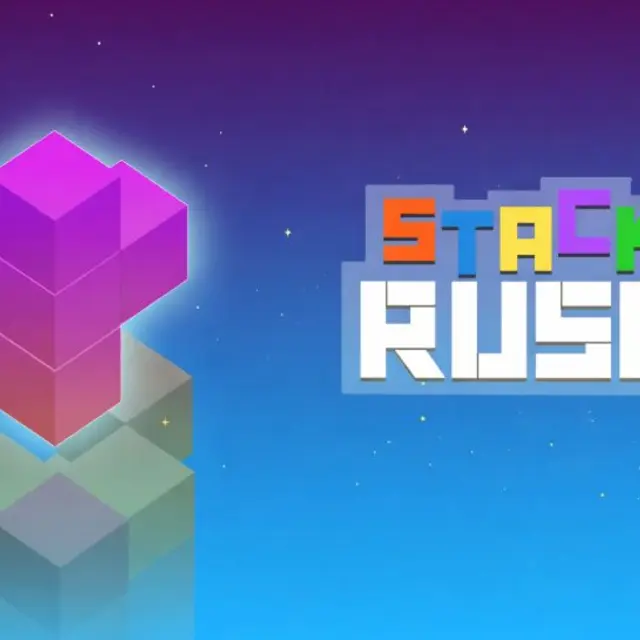
- Genre Puzzle games
- Players 1
- Session 7 min
- Price Free
- Updated
A falling-block puzzle wrapped around a cube. Instead of rotating the piece, you rotate the platform, which sounds like the same thing and is not: turning the cube changes which face is receiving the next block and leaves every other face exactly as you left it. Filling a complete horizontal layer clears it, so the goal is the familiar one, but the planning is genuinely different because you are managing four surfaces at once and can only see two of them clearly. It rewards players who think a couple of pieces ahead and punishes anyone who solves each block where it lands.
| Left and right or swipe | Rotate the cube |
|---|---|
| Down | Drop the block faster |
| Touch | Swipe to rotate, tap to drop |
How to play Stack Rush
- Keep all four faces roughly level. A tower on one side blocks the layer clears that need every face.
- Rotate to the emptiest face when a piece does not obviously fit, rather than forcing it where you are looking.
- Plan for the layer rather than for the piece. A block placed badly but low is better than a neat one placed high.
- Check the faces you cannot see before committing. Most mistakes are made on the far side of the cube.
- Drop early once you are certain. The extra seconds do not help and the speed increases anyway.
Tips
- Combos come from clearing consecutive layers, so a slightly slower build that sets up two clears beats a fast single one.
- Rotating costs nothing, so turn the cube to look before every placement rather than after.
- If the stack is uneven, spend two or three pieces levelling it rather than building higher.
Questions about Stack Rush
Do I rotate the blocks or the cube?
The cube. Pieces fall as they are and you turn the platform to receive them.
How does a layer clear?
When a complete horizontal ring around the cube is filled, it clears with a bonus.
Does it speed up?
Yes, progressively, as in most falling-block puzzles.
Is it playable on a phone?
Yes, swiping to rotate is a natural fit.
Is there an end?
No, it is a score chase built on how long you can keep the stack manageable.